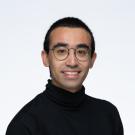
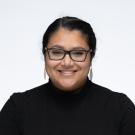
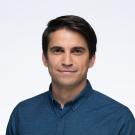
One of our own soon-to-be-graduating PhD students, Nick Aoki, has received one of Graduate Studies' annual "Outstanding Graduate Student Teaching" awards (OGTA), valued at $1,000! This award recognizes the contributions of graduate students who thrive in teaching positions at UC Davis. Nick has demonstrated on multiple occasions that he has a natural penchant for instruction, and this readily shines through in not only his interactions with students, but also his stance on the world of linguistics and language-related pedagogical practices more broadly.
Last month, one of our graduate students, Mohamed Afkir, along with his advisor Georgia Zellou, published a new book on the phonetics of Mohamed's native language: Tarifit. Officially titled "The Phonetics of Tarifit: Variation and Change in a Moroccan Amazigh Language," this book is a comprehensive overview of a language that has historically lacked significant research on its inherent phonetics.
We would like to congratulate one of our recent PhD graduates, Dr. Ashley Keaton, who has been awarded a three-year research grant at the University of Iceland in Reykjavik! A prominent member of our Phonetics Lab, Dr. Keaton did research that focused on speech sciences, human-computer interaction, and AI speech. This fellowship in Iceland perfectly aligns with her recent qualifications.
Drs. Luna Filipovic and John Hawkins have just published a new joint paper in the Journal Transactions of the Philological Society, an international journal for the structure, history, and relationships of language. They publish synchronic and diachronic studies of the widest possible range of languages and language families from the perspective of any of the subdisciplines of descriptive and theoretical linguistics. It is the oldest journal in the world having continuous publications in general linguistics.
Congratulations to Professor Raúl Aranovich for being chosen as a new associate editor for the journal Language & History. He is now one of only two current members from the United States on this large editorial board.
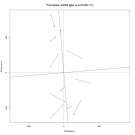
JC was accepted to present at the conference "Methods and Techniques in Phonetic Science" back in August and officially gave his presentation this weekend (October 17 - 19, 2025). His presentation was titled "An Evaluation of Seminal Vowel Space Models Using Real-World Acoustic Data." In his talk, he explained some of the methodological challenges faced by Liljencrants & Lindblom (1972) in their work on predicting how vowel spaces are affected by vowel inventory size.
Linguists from six UC campuses, including UC Davis, were awarded a multi-campus grant through the UC Multicampus Research Programs and Initiatives. Together with linguists from UC Santa Cruz, UC Santa Barbara, UC Merced, UC Irvine, and UCLA, they will be studying the intersection of language technology and language diversity. They will be asking how new language technologies such as ChatGPT respond to diverse language varieties, and how we can improve such technologies to better support the language diversity of the California population.
Emily Morgan was awarded a three-year NSF grant on "Generalization versus item-specificity in language processing and change". The project will investigate how speakers of a language use both the ability to generalize and their knowledge of specific previously-encountered items. For example, speakers know that the past tense of a novel verb glorp is glorped but the past tense of run is the irregular ran. But the relationship between these two systems remains a subject of intense debate.
Congrats to Dr. Masoud Jasbi for receiving a College of Letters and Science Teaching Award! Click the link below to learn more about Dr. Jasbi's teaching philosophy:
Abstract: Language is a complex system. Each individual speaker’s behavior reflects myriad social and cognitive processes. Jointly all these speakers’ behaviors give rise to the patterns of language use which can be observed in corpora. This system is also adaptive: a speaker’s behavior is based on their past interactions. And these interrelated patterns of experience affect how the language changes over time. In this talk, I will discuss some new work on the relationship between adaptation at the individual speaker level and diachronic change at the language level.
Congrats to Melissa Gomes (Linguistics PhD student, advisor: Aranovich) for receiving a Public Scholars for the Future Fellowship for the 2024-2025 academic year! The "program prepares the next generation of public scholars to integrate community-centered theories, methods and techniques into their disciplinary field of study, research design and methods".
Click the link below to learn more about Melissa's project on Konkani, her family's heritage language:
Abstract: Born of a political will to standardize regional pronunciation and to contend with the many non-European languages of overseas Empires, the “universal alphabets” that emerged across Europe in the mid-nineteenth century sought to devise a single set of symbols capable of transcribing all possible sounds of human speech. How does one even envision such sounds? What models emerge to enable their anticipation? This chapter tells the story of the prominent and persistent model that presents vocalic sound in the image of a color triangle.
Abstract: This presentation will address the lack of ideophones in the current linguistic descriptions of Mocho’, a highly endangered Mayan language spoken in Chiapas, Mexico. Most Mayan languages have a lexical class known as “affective” words (Kaufman 1971). This class can belong to a root class and/or a derived type of predicate (Polian 2017).
Abstract: In this talk, I present work exploring the storage of prefixes, and the processing of prefixed words. Although much theoretical work has addressed complex words and the role affixes play in the construction of meaning (cf. Taft & Forster, 1975; Schreuder & Baayen, 1995; Marslen-Wilson & Tyler, 2007), nearly all of this discussion is couched in arguments about compositionality and semantic opacity.